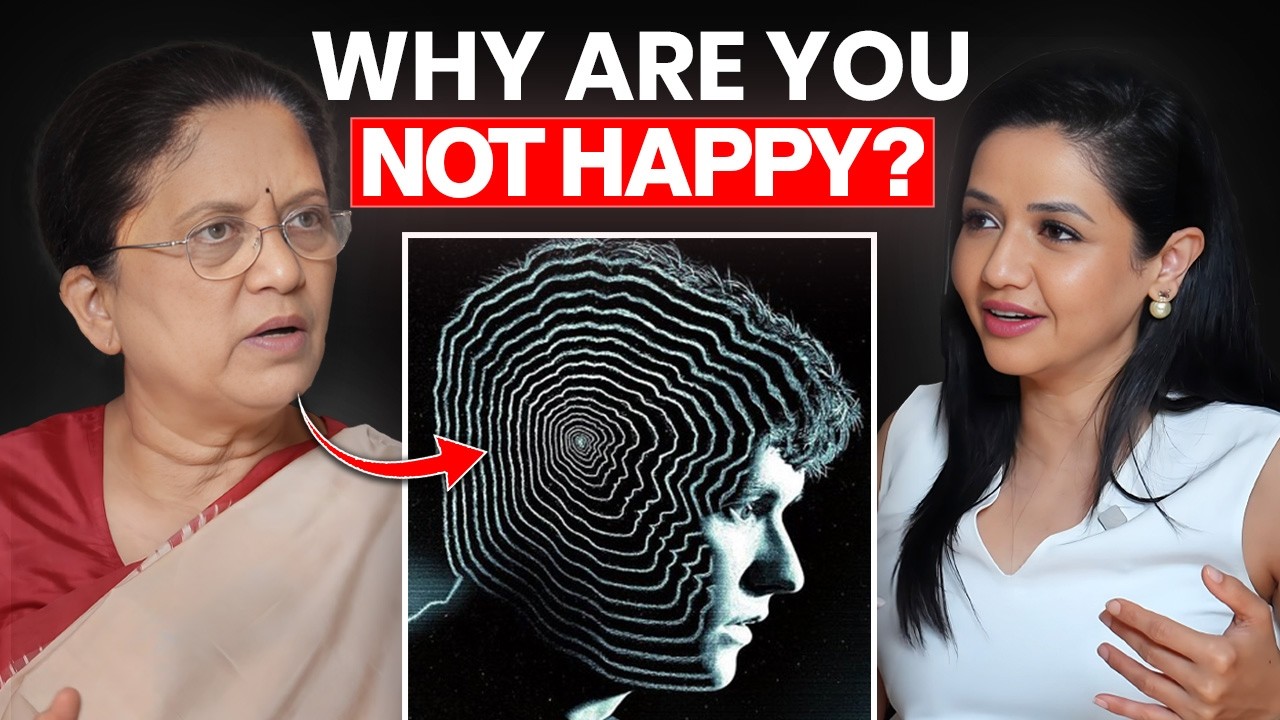
Jaya Row🧠 Self-Growth & Mindset
← All Guests

Jaya Row

World-Renowned Vedanta Speaker | 45+ Years of Research | Founder, Vedanta Trust

Episode Views

66.6K

Topic

🧠 Self-Growth & Mindset

Watch Episode on YouTube

Episode: Your Brain is Addicted to Pleasure — Fix This Before It's Too Late!

About Jaya Row

Jaya Row stands as India's foremost contemporary Vedanta teacher, a position she has maintained with unwavering dedication for more than four decades. Her podcast episode, "Your Brain is Addicted to Pleasure - Fix This Before It's Too Late!," distills her life's work into a message that resonates across the spirituality pillar and far beyond it, capturing 66,562 views from audiences hungry for authentic wisdom about the human condition. In an age of dopamine-driven digital experiences, algorithmic manipulation, and pleasure-seeking that leaves people spiritually empty, Jaya Row emerges as a voice of profound clarity, offering ancient Vedantic solutions to distinctly modern problems. Her ability to make these timeless teachings relevant to contemporary life has made her a guide for executives, students, spiritual seekers, and anyone grappling with the disconnect between pleasure and lasting happiness.

Jaya Row's journey as a Vedanta teacher is itself a remarkable chapter in the contemporary spiritual landscape of India. Having dedicated forty years to studying, practicing, and teaching Advaita Vedanta—one of the most rigorous and intellectually demanding spiritual philosophies—she has become a bridge between ancient wisdom and modern consciousness. Unlike many spiritual teachers who emerged from ashrams or monastic traditions, Jaya Row's approach carries the accessibility of someone deeply embedded in contemporary life. She understands technology, modern psychology, neuroscience, and the challenges facing working professionals. Her teaching doesn't require listeners to abandon their lives or retreat to mountaintop monasteries; instead, it offers a framework for living with wisdom while fully engaged with the world. This integration of timeless philosophy with contemporary context is precisely what makes her teaching so potent and relevant.

The central distinction Jaya Row makes between pleasure and happiness constitutes perhaps her most revolutionary contribution to modern spiritual discourse. This distinction is not merely semantic; it is fundamental to understanding why so many people feel empty despite constant access to pleasure. Pleasure is reactive—it depends on external stimuli, on the satisfaction of desires, on the stimulation of senses. When you experience something pleasurable—a good meal, a compliment, a purchase, a social media like—your brain releases dopamine, creating a temporary sense of satisfaction. But pleasure is inherently temporary because it depends on circumstances that are always changing. The meal is eaten, the compliment fades, the purchase loses its novelty, the social media engagement moves to the next post. Pleasure, by its very nature, is followed by a return to baseline, and then often by a craving for more.

Happiness, by contrast, is not dependent on external circumstances. In Vedantic terms, happiness is your fundamental nature—it is not something you achieve or acquire but something you uncover by removing the obstacles to its recognition. This distinction transforms how one approaches life's challenges and choices. Rather than constantly seeking external conditions that will produce pleasure (which is ultimately a losing strategy), Vedanta invites us to question the seeking itself and to recognize that the happiness we seek is not available through any amount of external acquisition. This teaching is radically subversive to consumer culture, to the attention economy, to the entire machinery of modern marketing. It suggests that the path to genuine fulfillment doesn't run through more pleasure but through understanding pleasure's nature and transcending the addiction to it.

The phenomenon of dopamine addiction in modern society has become increasingly visible as neuroscience reveals how our brains respond to stimulation. Technology companies deliberately engineer their products to maximize dopamine hits: notifications, variable rewards, infinite scrolls, and algorithmic feeds are all scientifically designed to keep users engaged and craving more. Social media has become a dopamine vending machine, and billions of people have become addicted without recognizing the addiction for what it is. The human brain, evolutionarily designed for scarcity, is now swimming in abundance and stimulation that far exceeds what natural selection prepared us to handle. Jaya Row speaks to this crisis not from a position of judgment but from genuine understanding. She doesn't condemn technology or pleasure; she illuminates how dopamine-driven pursuits leave us perpetually unsatisfied and cut off from the deeper happiness that is our birthright.

Her practical Vedantic solutions for the digital age represent the real gift of her teaching. Rather than offering another self-help approach that engages with the problem at its own level—proposing more discipline, better habits, digital detoxes—Vedanta cuts to the root. The solution isn't to perfect your pleasure-seeking but to question why you're seeking at all. Jaya Row teaches simple practices: meditation, self-inquiry, conscious living, and the study of Vedantic texts that illuminate the nature of the self. She offers the philosophical framework that allows seekers to recognize their entanglement with pleasure-seeking and to begin the process of disidentification from these compulsive patterns. She teaches that happiness is not rare, distant, or dependent on special circumstances; it is available right now, beneath the overlay of mental chatter and compulsive seeking. This doesn't mean life becomes less engaging; it means life becomes more authentic and aligned with genuine values rather than programmed desires.

What truly distinguishes Jaya Row is her unique ability to make ancient scripture relevant without diluting it. She speaks with sophisticated understanding of texts like the Upanishads, the Brahma Sutras, and the Bhagavad Gita, offering interpretations that honor their depth while making them accessible to modern practitioners who have never studied Sanskrit or Indian philosophy. She doesn't require belief; she invites investigation. She doesn't demand faith; she offers a logical framework that can be tested through direct experience. This approach has made her particularly beloved by analytical minds—engineers, scientists, business leaders—who appreciate Vedanta's intellectual rigor and its empirical verification through practice.

Her global reach extends to executive coaching and workshops in corporate settings, where high-performing professionals discover that their external success has not delivered the internal fulfillment they anticipated. These encounters often become transformative moments when someone who has achieved every external goal finally confronts the question of why they still feel empty. Jaya Row meets such seekers with compassion and clarity, offering a framework for understanding this apparent paradox and pointing toward authentic fulfillment. Similarly, university students and young people grappling with existential questions find in her teaching a sophisticated alternative to both religious dogma and nihilistic materialism.

The reason her message of heart-centered living combined with intellectual clarity resonates so profoundly is that it addresses the deepest crisis of our age: the crisis of meaning. Material abundance hasn't delivered happiness; technological progress has given us more options but not more peace; the pursuit of pleasure has made us less satisfied, not more. Jaya Row's Vedantic teaching offers a genuinely alternative path—one that doesn't require rejecting the world but rather understanding the world correctly. Her forty years of dedicated teaching, her willingness to evolve her presentation while maintaining the purity of the philosophy, and her genuine compassion for the human struggle have made her the voice that millions turn to when they finally ask the only question that truly matters: "What is this consciousness that I am, and why have I forgotten my own nature?"

Free Download

Get DJP's Secret Blueprint

Divya's personal playbook on life, money, and growth — distilled from 900+ podcast conversations. Enter your name and email to get instant access.

No spam, ever. Unsubscribe anytime.