✨ Spirituality & ManifestationDevdutt Pattanaik
Medical Doctor & Mythologist | 50+ Books | Forbes India Celebrity 100
24.6K
✨ Spirituality & Manifestation
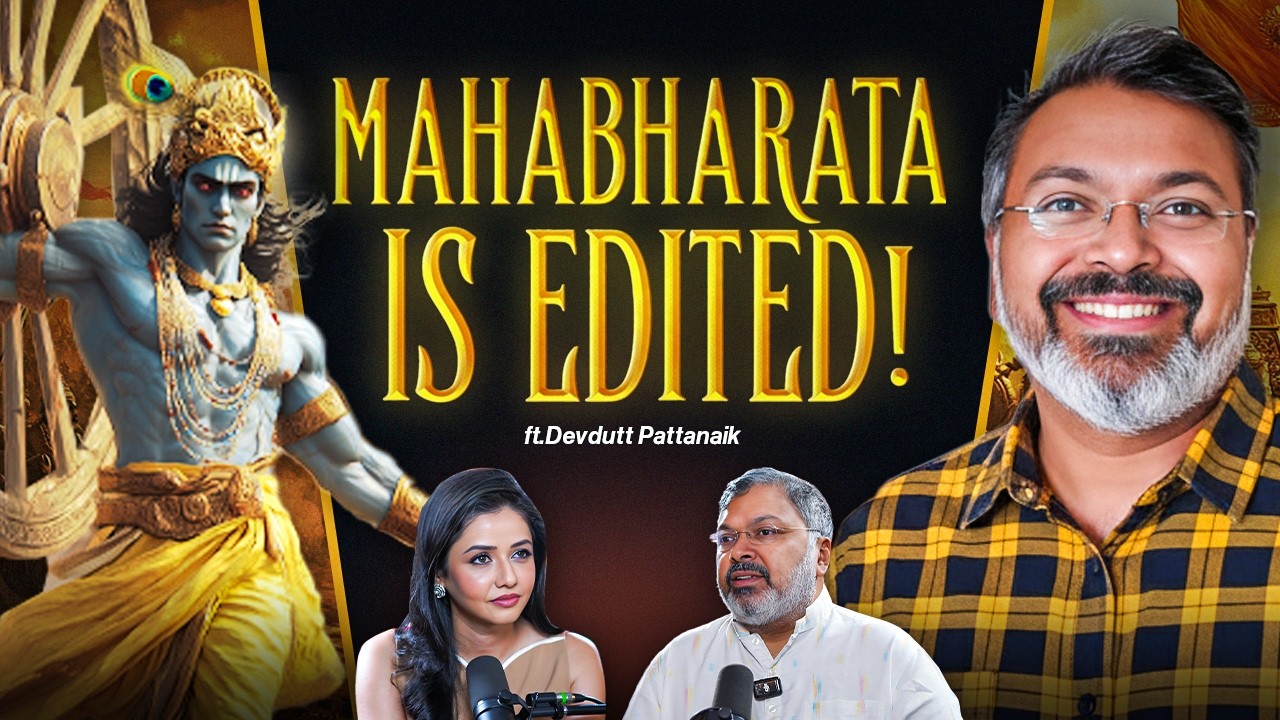
Episode: Find Out the Hidden Truth of Mahabharata & Ramayana
About Devdutt Pattanaik
Devdutt Pattanaik stands as India's foremost mythologist, having dedicated his prolific career to revealing hidden truths within ancient epics and demonstrating how mythology continues to explain contemporary India. As author of over 50 books, cultural commentator, and thinker, Pattanaik has fundamentally transformed how Indians understand their own cultural heritage. His approach dispels the Western academic prejudice against mythology as inferior to literal history, instead revealing how myths encode sophisticated philosophical truths and psychological insights that remain profoundly relevant.
Pattanaik's unique contribution lies in his willingness to question conventional interpretations of the Mahabharata and Ramayana—sacred texts that form the spiritual foundation of Hindu culture. Rather than treating these epics as fixed historical narratives, he reveals their fluid nature, multiple variations, and deliberate ambiguities that different audiences and traditions have interpreted in distinct ways. This scholarly sophistication allows him to explore hidden truths embedded within these texts: philosophical principles, psychological teachings, ethical dilemmas without simple solutions, and complex reflections on power, duty, love, and dharma.
His featured episode "Find out the hidden truth of Mahabharata & Ramayana" addresses profound mysteries that have captivated Indian consciousness for millennia. With 24,590 views, this episode has introduced thousands to a more nuanced, intellectually satisfying understanding of these epics. Rather than simplistic narratives of good versus evil, Pattanaik reveals how these stories explore moral complexity, competing claims of justice, and the impossibility of perfect solutions within real human circumstances. This deeper interpretation validates the centuries of philosophical debate these texts have generated.
The Mahabharata, one of the world's longest literary works, contains far more than historical narrative. Pattanaik recognizes it as a vast repository of Vedic teachings, philosophical inquiry, and practical wisdom about human nature and society. The apparent conflicts in the text—inconsistencies, contradictory teachings, seemingly unwarranted character actions—are not flaws but deliberate features inviting readers to think deeply. By accepting ambiguity and exploring alternative interpretations, readers develop the philosophical sophistication necessary to navigate real life's genuine moral complexity. The seemingly straightforward tale of the Kurukshetra war becomes a profound inquiry into the nature of war, justice, duty, and kingship.
The Ramayana presents similar depths. Pattanaik reveals how different regional traditions and interpretations offer radically different versions of Rama's story, each revealing distinct philosophical truths. The idealized Rama of popular imagination differs substantially from the complex, sometimes questionable figure portrayed in various Ramayana versions. Rama's abandonment of Sita, his actions in slaying Ravana, his fraught relationship with various family members—these narratives invite readers to question simplistic morality and explore human complexity. By examining these difficult aspects, one discovers the text's genuine power: not as propaganda for uncritical obedience but as honest exploration of how even noble individuals face impossible choices.
Pattanaik's approach transforms mythology from entertainment or religious doctrine into sophisticated philosophical inquiry. Rather than defending mythology against rationalist critique, he demonstrates that mythology operates in different registers than literal history or empirical science. Mythology encodes psychological and philosophical truths in narrative form, making these truths emotionally resonant and memorable. A good myth teaches more effectively than abstract philosophy because it engages the whole person—intellect, imagination, emotion—simultaneously.
His prolific writing—over 50 books exploring mythology, rituals, symbols, and their cultural significance—demonstrates extraordinary depth of knowledge and relentless generosity in sharing insights. His books cover specific texts like the Ramayana and Mahabharata, cultural practices and their symbolic meanings, modern India's relationship to traditional wisdom, and the universal patterns of mythology across cultures. This breadth reveals how mythology is not merely historical artifact but ongoing framework through which humans understand themselves and their world.
Pattanaik's most significant insight may be recognizing how mythology continues to explain modern India. Beneath contemporary politics, social movements, economic development, and cultural tensions lie mythological patterns and ideas that remain deeply influential. Understanding Indian society requires recognizing these mythological substrates: concepts of authority and dharma, hierarchies and relationships, narratives of injustice and redemption that continue driving contemporary discourse. By revealing these hidden patterns, Pattanaik helps Indians understand their own culture more profoundly.
His work addresses a profound cultural problem: many educated Indians have internalized Western perspectives that dismiss their own mythology as inferior, historical, or merely religious fiction. This internalized colonialism prevents genuine engagement with India's profound intellectual heritage. Pattanaik's scholarship and popular writing demonstrate that Indian epics encompass philosophical sophistication comparable to and exceeding Western philosophy. By validating engagement with these texts, he enables Indians to draw from their own cultural resources with intellectual pride and genuine understanding.
His approach to mythology scholarship combines rigorous academic training with deep spiritual and cultural respect. He writes for scholarly audiences and popular readers simultaneously, never condescending to either. His ability to make complex philosophical concepts accessible without oversimplifying represents exceptional skill in pedagogy and communication. Whether discussing Vedic symbolism or contemporary India's mythological underpinnings, Pattanaik maintains intellectual rigor alongside cultural sensitivity.
Pattanaik's legacy extends beyond individual books and episodes to his contribution to restoring mythology to its proper place in educated discourse. For too long, educated elites dismissed mythology as superstition or primitive thinking. Pattanaik's work demonstrates that mythology represents sophisticated attempts to engage with fundamental human truths: the nature of good and evil, the meaning of duty and justice, how to live nobly in an imperfect world. By revealing hidden truths within the Mahabharata and Ramayana, he invites readers into deeper relationship with texts that have shaped Indian consciousness across millennia, offering wisdom that remains profoundly relevant to contemporary challenges.
Related Podcast Episodes
Long-form conversations featuring or related to Devdutt Pattanaik
Related Shorts
Quick clips on similar topics
Get DJP's Secret Blueprint
Divya's personal playbook on life, money, and growth — distilled from 900+ podcast conversations. Enter your name and email to get instant access.