🧠 Self-Growth & MindsetMaj Gen Yash Mor
Third-Generation Army Officer | Sena Medal (Gallantry) | First GOC Ladakh
62.6K
🧠 Self-Growth & Mindset
Episode: Inside Deadly Training of Indian Army Jawaans
About Maj Gen Yash Mor
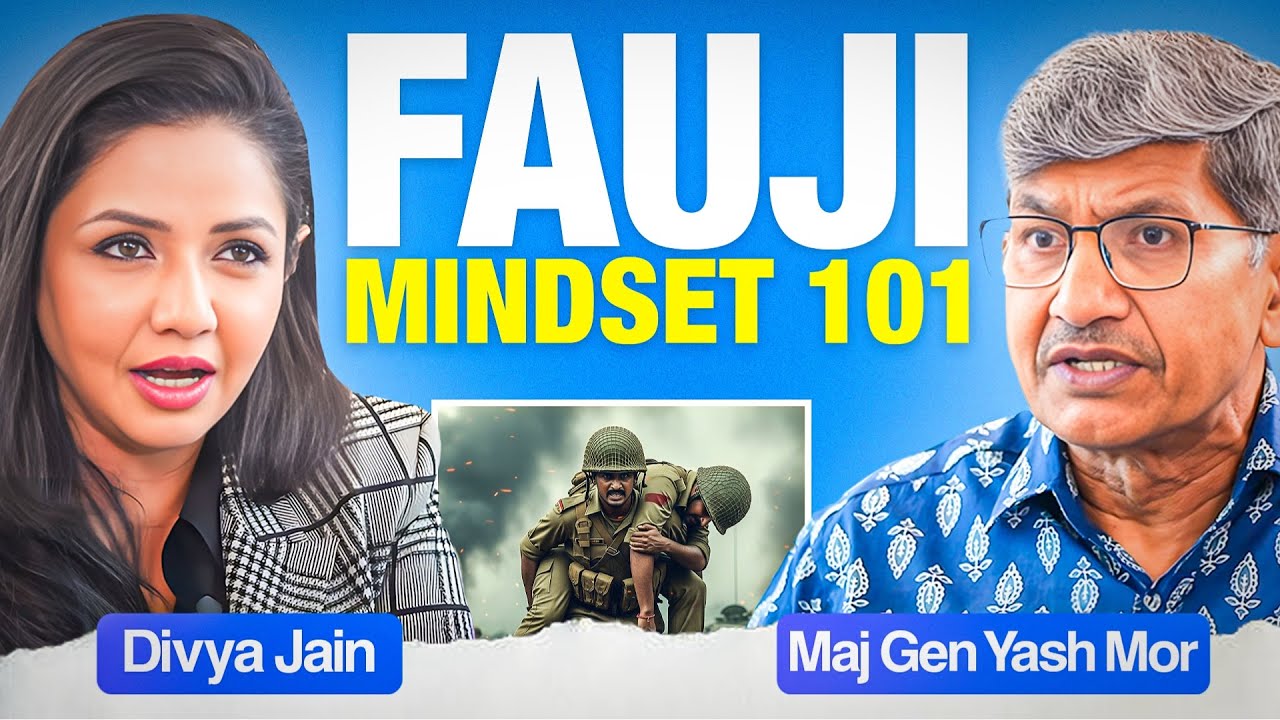
Maj Gen Yash Mor stands as one of the Indian Army's most respected military leaders and educators, bringing insider perspective on one of the world's most challenging military training regimens. His podcast episode, "Inside DEADLY Training of the Indian Army Jawaans," has captivated 62,554 viewers, offering them a window into the brutal transformation that converts ordinary Indian civilians into world-class soldiers. His appearance on the show embodies the self-growth pillar in its most extreme form: the deliberate, systematic destruction and reconstruction of the human being, undertaken not for sadistic purposes but to forge individuals capable of functioning with excellence under conditions of extreme duress, sleep deprivation, pain, and fear. Maj Gen Mor's willingness to openly discuss the psychological and physical breaking points of military training has shattered myths about soldier training and offered profound insights applicable far beyond the military context.
The brutal transformation from civilian to soldier represents a process so complete and comprehensive that it fundamentally reshapes a person's psychology, physiology, and relationship with their own capabilities. Most civilians, particularly those from comfortable middle-class backgrounds, have never experienced anything approaching the intensity of military training. Their lives have been structured for comfort, safety, and the avoidance of discomfort. Military training reverses every assumption they hold about what is acceptable, possible, and necessary. The first shock is usually physical: the sudden demand for physical exertion that exceeds anything the recruit has ever experienced, performed on inadequate sleep and minimal food. The body, pushed beyond imagined limits, begins to reveal its vast reserves of capability. A civilian recruit discovers that they can run farther, carry heavier loads, and endure more pain than they believed possible. This physical transformation is not the end point but merely the beginning of the real work: psychological transformation.
Maj Gen Mor revealed specific training regimens that illustrate the methodology behind military transformation. Extended route marches, sometimes covering 50+ kilometers with heavy loads, are undertaken to test and expand mental toughness. Live ammunition exercises, while conducted under safety protocols, expose soldiers to the genuine acoustic and psychological trauma of combat. Sleep deprivation experiments reveal how human judgment, decision-making, and physical capability deteriorate under extreme fatigue, teaching soldiers to function even when depleted. High-altitude training in regions like Siachen and the Himalayas tests soldiers' capacity to perform in environments where the body rebels and oxygen is scarce. Underwater combat training, particularly for elite units, pushes soldiers to the edge of panic and beyond, teaching them to function even when every instinct screams to escape. Interrogation resistance training exposes soldiers to psychological techniques that could be encountered by prisoners of war, building psychological resilience. These aren't theoretical exercises but viscerally demanding experiences that permanently alter one's relationship with discomfort and fear.
The physical and psychological breaking points that Maj Gen Mor discusses represent the hidden curriculum of military training. The physical breaking point is the moment when the body genuinely cannot continue—when muscles have been taxed beyond recovery, when glycogen stores are depleted, when the nervous system is overstimulated. Paradoxically, most soldiers discover that their physical breaking point comes much later than they imagined, and that the human body has profound reserves that kick in under extreme demand. The psychological breaking point is subtler and more critical: it's the moment when the mind decides that further effort is impossible, when fear or despair or exhaustion overwhelms the will to continue. Training is designed to systematically take soldiers to this psychological breaking point and beyond, showing them that this point is not, in fact, the limit of their capability. A soldier who has been broken psychologically in training and continued anyway knows that genuine mental limits are far beyond where they previously imagined. This knowledge becomes an immense source of confidence and capability.
Leadership forged in extreme conditions produces a fundamentally different type of leader than training room seminars can develop. Officers like Maj Gen Mor don't merely study leadership theory; they live leadership in contexts where mistakes have lethal consequences, where soldiers look to them for guidance when scared, where their decisions determine whether people return home or return in body bags. This lived responsibility creates leaders of extraordinary caliber. They understand that leadership is not about being liked or charismatic or eloquent; it's about maintaining clarity when everyone around you is panicking, making sound decisions under extreme time pressure, and accepting responsibility for outcomes beyond your control. Officers trained in such environments develop moral authority that can't be taught in classrooms.
Why Indian Army training produces world-class soldiers reflects both methodology and cultural factors. The methodology emphasizes comprehensive physical and psychological conditioning integrated with rigorous tactical training. The Indian Army, with decades of counter-insurgency experience in Kashmir, the Northeast, and other regions, has refined training approaches that produce soldiers capable of operating in ambiguous, dangerous, complex situations. But beyond methodology lies cultural factors: Indians, coming from a context where poverty, overcrowding, and resource scarcity are common, often have greater reserves of psychological resilience and acceptance of discomfort than soldiers from more affluent nations. The diversity of the Indian Army—recruiting from virtually every region, caste, religion, and socioeconomic background—requires training that builds cohesion and trust across lines of tremendous difference. This demand for integration produces soldiers capable of functioning effectively in diverse teams and handling the complexity of modern warfare and peacekeeping.
What civilians can learn from military discipline extends far beyond military application. The primary lesson is that human capacity is vastly greater than imagined and that this capacity is unlocked through systematic challenge. In civilian life, we tend to avoid discomfort, to retreat from situations that produce anxiety or pain. Military training teaches the opposite: that growth happens at the edge of capability, that discomfort is information rather than something to avoid, and that sustained effort over time can produce transformations that seem impossible from the comfort of the couch. The discipline learned in military training—the ability to do what needs to be done regardless of emotional state, the willingness to persist despite fatigue and doubt, the integrity to maintain standards when no one is watching—these virtues, when applied to civilian pursuits, produce extraordinary results. The willingness to be uncomfortable in service of growth, the understanding that difficulty is not a sign of choosing wrong but of choosing correctly, and the recognition that character is built through challenges rather than in comfort—these are military lessons that apply universally.
Maj Gen Mor's episode revealed something else crucial: the respect and even gratitude that properly trained soldiers feel toward training that broke them. They understand, in retrospect, that their trainers weren't tormenting them capriciously but were deliberately taking them to the edge of capability to expand it. This reframing of difficulty—from punishment to be avoided to gift to be received—represents one of the most profound psychological shifts possible. Applied to civilian life, it suggests that the parents, teachers, coaches, and mentors who challenged us most, who pushed us beyond comfort, who refused to accept excuses, were the ones who served us best. In a culture that increasingly emphasizes comfort, safety, and the avoidance of challenge, Maj Gen Mor's message about the necessity of difficulty for genuine growth carries radical import.
The 62,554 viewers who watched his episode received far more than military trivia; they received a masterclass in human potential and the methodologies through which ordinary people can transcend their perceived limitations. Maj Gen Yash Mor represents the highest expression of military education: a leader who uses his authority and experience not to demand blind obedience but to educate civilians about the hidden capacities within themselves and the discipline required to access them.
Related Podcast Episodes
Long-form conversations featuring or related to Maj Gen Yash Mor
Related Shorts
Quick clips on similar topics
Get DJP's Secret Blueprint
Divya's personal playbook on life, money, and growth — distilled from 900+ podcast conversations. Enter your name and email to get instant access.